

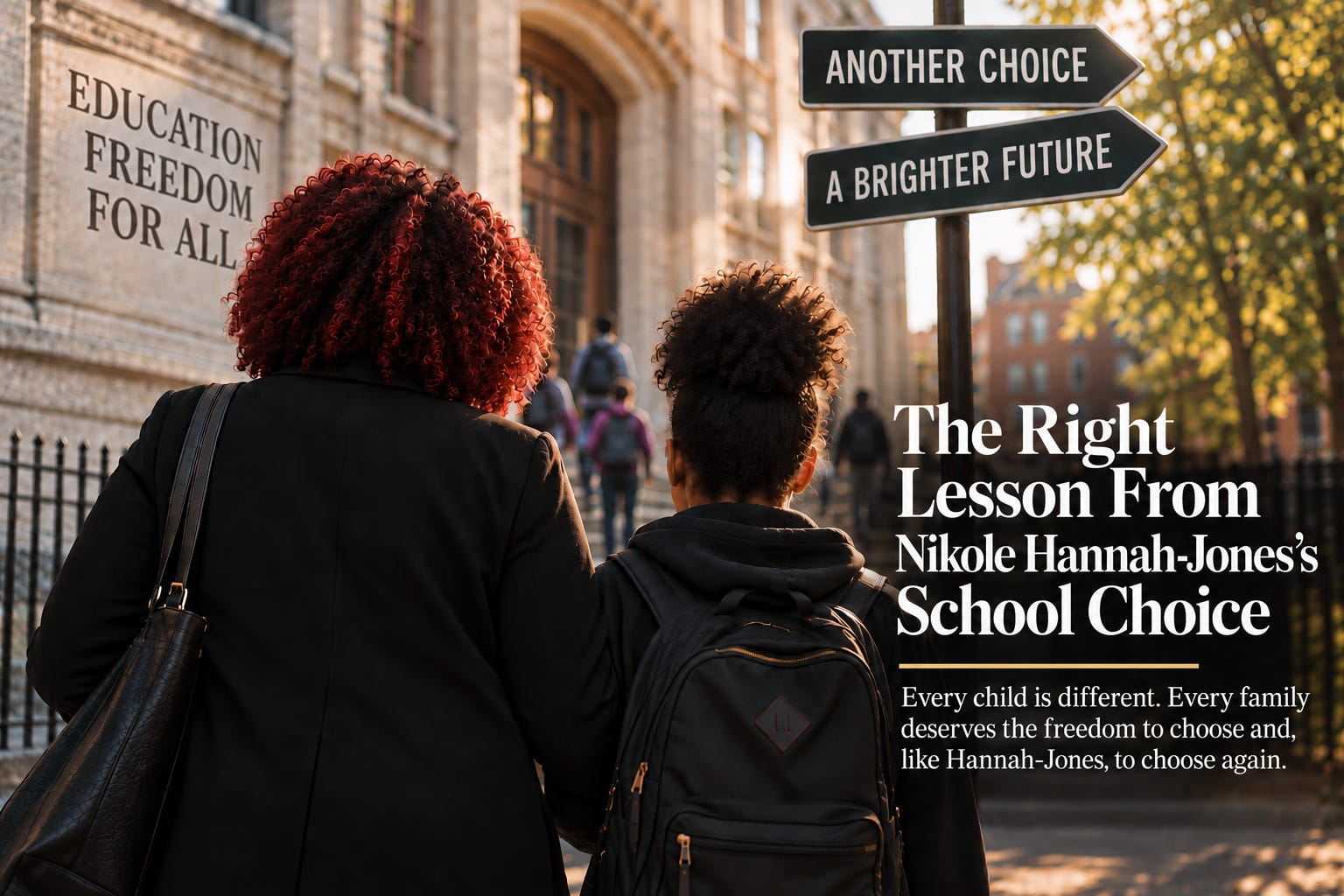
A decade ago, Nikole Hannah-Jones made a choice. The New York Times Magazine writer chose to enroll her daughter, Najya, in a high-poverty public school in Bedford-Stuyvesant, Brooklyn. She had other options. That was the point. Hannah-Jones believed families with resources and influence owed something to schools serving children who had neither.
Her daughter would eventually confront a colder lesson. When an individual child is asked to carry the weight of a system’s failures, it is the child who pays.
Some online are gloating over what Hannah-Jones revealed this week: that she now regrets the decision. They shouldn’t. Her story makes a far better case for educational freedom than anything they could have written themselves.
By fourth grade, Najya was behind across her subjects and had not been assessed as proficient in reading. In middle school, under a schoolwide policy pushing algebra on students before they’d mastered the basics, she earned A’s in the subject. An outside tutor later found Hannah-Jone’s daughter had never mastered long division or fractions, the arithmetic the algebra was supposed to sit on top of.
Then came the sentence that should follow every education policymaker home. “Sometimes I wish instead of always thinking about other kids, you would have thought about me,” Najya told her mother. “I never really got the education I wanted.”
Hannah-Jones apologized. “I feel like you got cheated. And I’m sorry for that.”
That is not proof, as some of Hannah-Jones’s critics are claiming, that she is simply a bad mother reaping what she sowed. What the story actually indicts is narrower, and more damning. Hannah-Jones has spent years arguing against school choice: against vouchers and against the idea that a family should be able to opt a child out of a school that is failing them. In 2021, when critics pointed out that her own reporting doubled as an argument for choice, she pushed back, calling vouchers a form of privatization that drains resources from the schools serving most children.
And yet her own essay is a story about nothing but her choices. She chose the school. When it produced years of documented problems, becoming, in her words, a “thorn in the principal’s side,” she chose to stay. When her daughter was old enough to insist, she chose, again, to let Najya leave for something better.
There is nothing wrong with any of that. It is what pluralism looks like. What is wrong is wanting credit for having choices while opposing the right of other families to have them too.
Hannah-Jones’s original instinct, that individual choices either uphold or erode a shared system, and that people with means owe a debt to that system, is a foolish one. It asks a single child to absorb, on faith, the future costs of somebody else’s theory of collective repair. Najya paid that price. She is now living out, in real time, the cold arithmetic of collectivism: when an institution is asked to improve and an individual child is asked to wait for it, the child bears the loss the institution does not.
The tragedy isn’t that Hannah-Jones was free to make that bet. It’s that millions of families are forced to make it whether they want to or not.
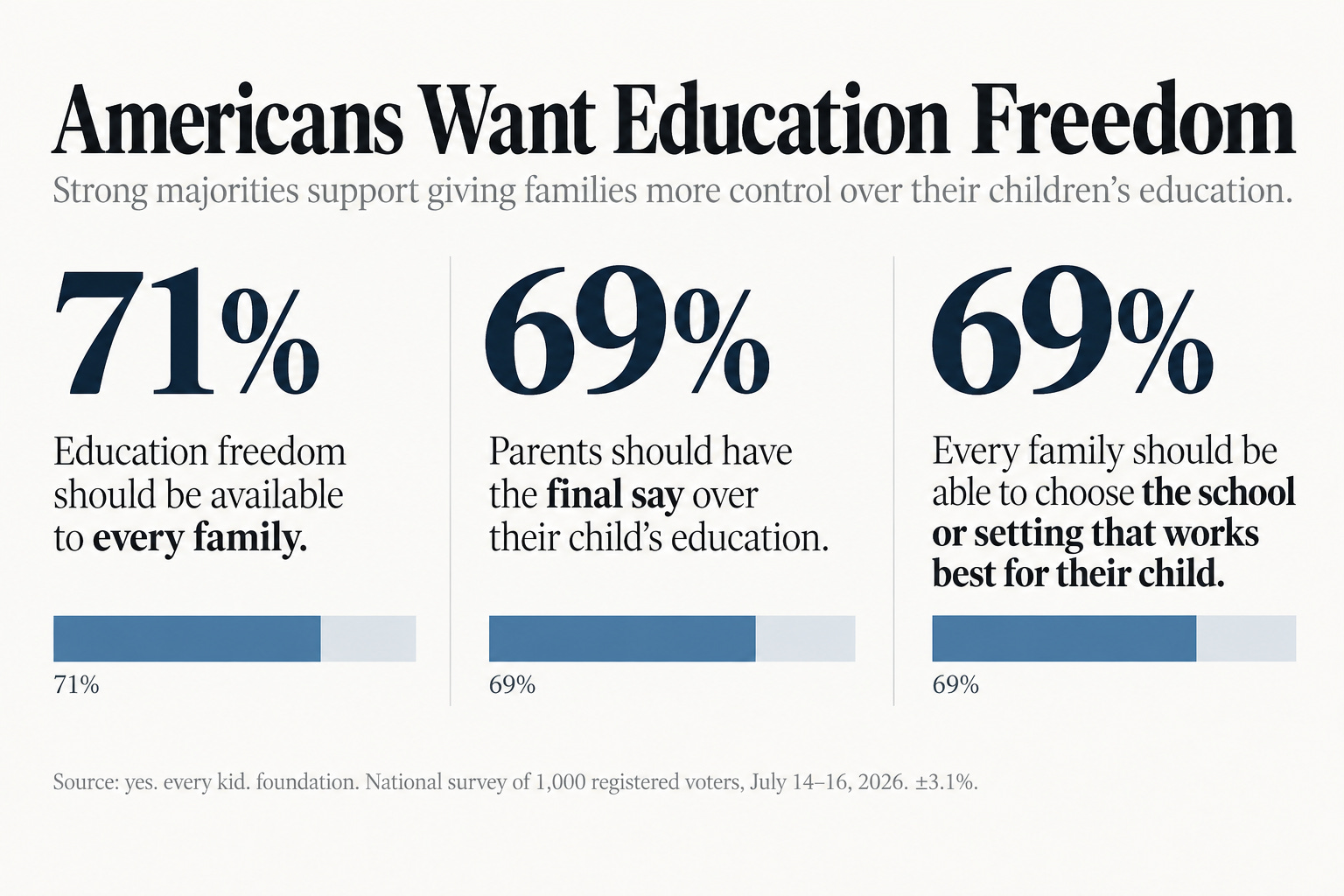
No distant superintendent, school board or curriculum office could have known what Najya needed in third grade, or what she was ready for in ninth. That knowledge lived with the people closest to her. A system that asks families to wait for someone else to discover it on their behalf is asking them to wait on information that was never going to arrive from that direction.
Spending is not the obstacle. New York City schools receives roughly $36,000 per student a year, among the highest rates in the country. That money did not buy Najya an education. It took a tutor Hannah-Jones paid for out of pocket to find the gaps her school never caught.
Instead, families are told to wait. Wait for a new superintendent. A new curriculum. Another reform plan. Wait for the system to improve on its own schedule.
Children do not have that kind of time. Freedom does not matter because parents are wise. It matters because no one else can run the experiment on a child’s behalf. Millions of families, each testing an answer against their own children, will find more of what works, and find it faster, than any single plan handed down in advance, because they are the only ones who learn immediately when they are wrong.
Hannah-Jones learned she was wrong. She had the standing, the resources and the time to correct it: to hire the tutor, to let her daughter change schools, to say, plainly, that she had not done right by her own child. Most families never get that chance. Not the initial choice. Not the years of runway to notice something has gone wrong. Not the door out once they do.
Wanting the choice, without wanting it for anyone else, is not idealism. It is privilege with a theory attached.
The answer to a choice that does not work is not less choice. It is another one.
Every child is different. Every family deserves the freedom to choose and, like Hannah-Jones, to choose again.
Masterfully written.
Choosing a school and then choosing to change schools is the fundamental right of all parents. Funding should support that.
I agree that it’s a good case for school choice but there is also a glaring omission in that she doesn’t mention charter schools at all even though they proliferate in her exact neighborhood (some like Uncommon Schools have had very strong outcomes) and exist for the exact reason to address the issues that she is concerned about. I found it odd that she didn’t mention them or apparently consider them for her daughter.